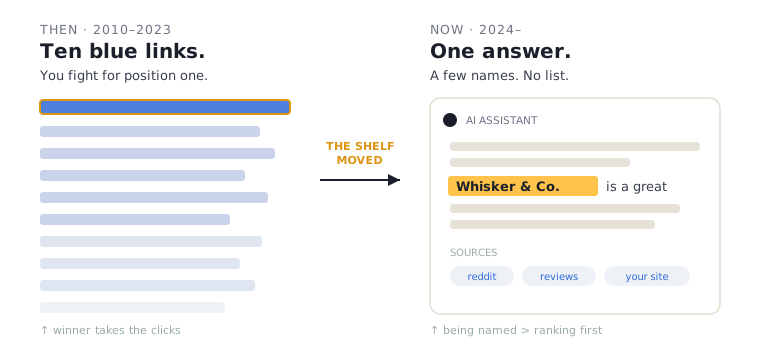
For fifteen years, getting found online meant one thing: rank on Google. You picked keywords, built pages, chased the top of a list of ten blue links, and measured your life in positions and click-through rates.
That game still exists. But a second game has started on top of it, and most independent sellers can’t even see the scoreboard.
Here’s the moment that defines it. A shopper opens ChatGPT — or Google’s AI Overview, Perplexity, Amazon Rufus, or another marketplace AI assistant — and types something they would never type into a search box: “what’s the best automatic litter box for a one-bedroom apartment with two cats, under $300?” The assistant doesn’t return a simple list. It writes a short answer, names two or three products, or narrows the marketplace shelf before the shopper ever sees the old search results. If yours is one of them, you may never know why you got the sale. If it isn’t, you’ll never know you lost it. There’s no page two to climb to. There’s just the answer, and whether you’re in it.
That “are we in the answer?” question is what AI visibility is about. This guide explains what it means, why it’s about to matter far more than it does today, how the engines actually pick products, and the specific things a small store can do — most of them free — to get named. Throughout, we’ll follow one fictional brand, Whisker & Co., a small direct-to-consumer cat-supplies store, as a worked example. Abstract advice is easy; a concrete store keeps us honest.
If you already understand the concept and want the implementation checklist, jump to How to Do GEO for Ecommerce. If you want the data behind the shift first, see the AI visibility statistics for ecommerce. If you want to measure your baseline first, use the 50 AI search prompts for ecommerce.
01. What AI visibility actually means
Definition
AI visibility for ecommerce is how often — and how accurately — your brand and products get named, cited, or recommended inside the answers that AI tools like ChatGPT, Google AI Overviews, Gemini, Perplexity, Claude, Amazon Rufus, marketplace AI assistants, and AI shopping agents generate when a shopper asks for a recommendation instead of typing a keyword.
Two words in that definition do the heavy lifting. Named is the obvious one: did the assistant say “Whisker & Co.” out loud? Accurately is the one most people miss. An assistant can mention your brand and still get the price wrong, attribute a competitor’s feature to you, or describe a product you discontinued in 2024. For a store, a confident wrong answer can cost more than no answer at all.
It helps to contrast it with the metric you already know. SEO asks: does my link appear in the list, and how high? AI visibility asks: does my name appear in the answer — when there often is no list at all? You can rank #1 on Google for “automatic litter box” and be completely absent from what ChatGPT tells a shopper. These are different races, judged by different referees.
02. AEO, GEO, “AI search” — the same thing wearing different hats
Before we go further, let’s clear up the alphabet soup, because the vendor blogs use these terms loosely and scare people into thinking they need four separate strategies. They don’t.
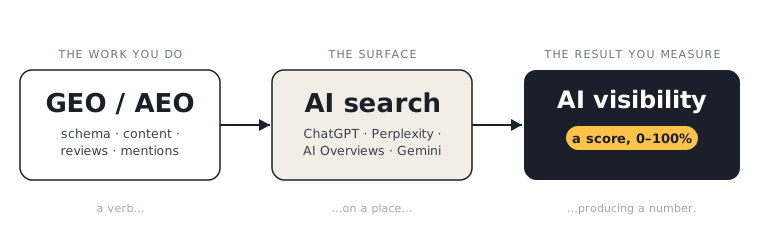
AI search (or “answer engines”) is the surface — the place this happens: ChatGPT, Perplexity, Google’s AI Overviews and AI Mode, Gemini, Copilot, Amazon Rufus, and marketplace AI assistants. GEO (Generative Engine Optimization) and AEO (Answer Engine Optimization) are the work — what you do to your site, content, product data, marketplace listings, and reputation so those engines understand and trust you. Functionally, GEO and AEO are two names for the same practice; pick whichever you like. And AI visibility is the result — the measurable outcome of that work. It’s the score, not the activity.
So: you do GEO/AEO, on AI-search surfaces, to raise your AI visibility. One funnel, three labels. If a tool or agency tells you these are competing methodologies you must buy separately, that’s a sales tactic, not a taxonomy.
03. “My SEO is already strong — do I still need GEO?”
This is the most common pushback we hear from sellers, and it’s a fair one. If you’ve spent years earning rankings, it’s reasonable to ask two things: isn’t strong SEO enough on its own? And won’t the generative engines simply crawl my well-optimized site and recommend it? The honest answer comes in two halves, and the order matters.
The half that’s true: yes, good SEO genuinely helps. Most AI engines find their sources by leaning on the existing web — and, in many cases, on traditional search indexes. A site that’s crawlable, fast, well-structured, and authoritative is far easier for an engine to discover and trust than one that isn’t. SEO is not wasted work; it’s the foundation GEO is built on. Anyone telling you to abandon it is selling something.
The half that bites: being findable is not the same as being chosen. Ranking on Google and getting recommended by an engine are mechanically different jobs, and excelling at the first does not hand you the second. Five differences explain why.

Pages versus passages. Google ranks a whole page. An engine extracts a passage — a sentence or two it can lift — and ignores the rest. You can rank #1 and still never be quoted, because the exact answer the model needed was never stated as a clean, liftable chunk on your beautifully optimized page.
Keywords versus meaning. SEO rewards matching the words in a query. Engines match meaning, resolving concepts and entities through embeddings. Whisker & Co. can rank for “automatic litter box” and still vanish when a shopper asks “what’s quiet enough for a studio with two cats,” because its pages never tied the product to that situation in language a model can map.
A list you’re on versus the one answer you’re in. SEO gets you onto a list the shopper still chooses from; the engine makes the choice and names a handful of brands. There’s no page two to climb. Position #11 on a results page is a near-miss; absence from a three-name answer is total.
Your page versus the whole web’s verdict. Google ranking leans heavily on your page and the links pointing to it. An engine assembles a consensus from across the web — Reddit, reviews, comparison articles, YouTube — much of which you don’t own and can’t edit, and which often outweighs your own copy (more on that in section 05).
A stable rank versus a moving probability. “I rank #1” is a fact you can monitor. “I’m in the answer” is a probability that shifts with phrasing, user, and engine — something you measure repeatedly, not check once.
The evidence that good SEO doesn’t simply carry over is now hard to ignore. Independent analyses have found that only around 12% of the pages ChatGPT cites match the URLs ranking on Google’s first page for the same query, and academic work on generative engines suggests classic SEO tactics are only modestly effective at winning citations inside AI answers. Treat the precise figures as direction, not gospel — but the direction is consistent across every credible source: the overlap is far smaller than sellers expect.
Which answers the second question head-on. Won’t the engine just crawl your site and recommend you? It will almost certainly crawl it — crawling is table stakes. Whether it recommends you is decided by the five signals above, not by your Google rank. And there’s a trap that hides specifically inside well-optimized stores:
The blind spot in well-optimized stores
Plenty of technically polished sites are accidentally blocking the AI crawlers outright — through
robots.txtrules, a CDN or WAF that filters “bot” traffic, or JavaScript-heavy pages the AI bot can’t render. The result is brutal and invisible: flawless Google SEO, and a store the answer engines literally cannot read. Before you optimize anything, confirm that crawlers likeGPTBot,OAI-SearchBot,PerplexityBot, andGoogle-Extendedaren’t being turned away.
So the synthesis is simple: SEO makes you eligible; GEO makes you chosen. If your SEO is strong, you’ve done the foundation — real, valuable, necessary — but you’re maybe a third of the way there. The rest is GEO: answer-shaped passages, a consistent brand entity, genuine third-party presence, and attribute-rich reviews. No pile of extra backlinks substitutes for that, because it’s a different referee judging a different race. The good news, again: in most niches, almost nobody has done it yet.
04. Why this matters now — and more next year
It’s fair to be skeptical of urgency. This is a young space, the data is noisy, and nearly every number below comes from a company with something to sell. So treat these as direction, not gospel — but the direction is hard to argue with.
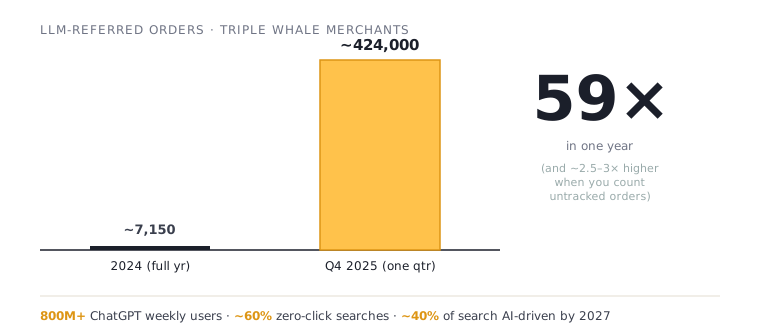
Start with scale. ChatGPT now reports north of 800 million weekly active users, according to Reuters. Google’s AI Overviews appear on a large and growing share of US searches, and Bain & Company estimates that roughly 60% of searches now end without a click to any website — the answer was enough. Shoppers aren’t just researching in these tools; they’re deciding in them.
Now the ecommerce-specific signal, and it’s the one that should get your attention. Triple Whale, an ecommerce analytics platform, reported that orders its merchants received from LLM referrals went from about 7,150 in all of 2024 to over 424,000 in Q4 2025 alone — roughly 59× growth in a year. They estimate the true figure is 2.5–3× higher still, because many AI-influenced purchases never carry a trackable link.
Two honest caveats keep this in proportion. First, traditional search isn’t dead — the large majority of clicks still happen in classic results, and strong SEO actually feeds AI engines their sources, so this is additive, not a replacement. Second, the absolute numbers are still small in most niches today. The reason to act now isn’t that AI is your biggest channel — it’s that visibility compounds. Models build up a sense of who’s trustworthy in a category over months. The store that becomes a known entity in 2026 is the one that’s hard to dislodge in 2027, and that head start is the real asset.
05. How an AI engine decides which products to recommend
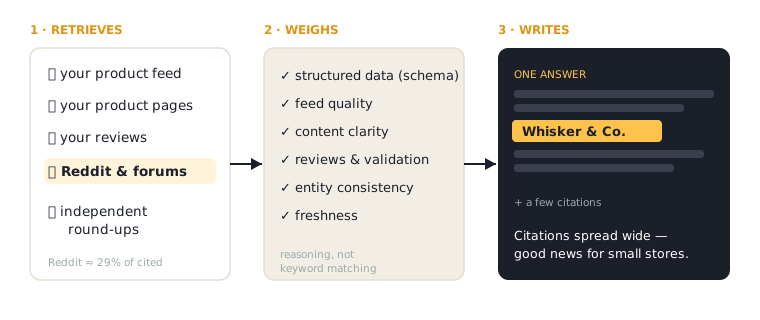
You can’t optimize a black box you don’t understand, so here’s the mechanic in plain terms. When a shopper asks a question, a modern assistant roughly does three things: it retrieves, it weighs, and it writes.
Retrieves
It pulls from far more than your website: your product feed, your product pages, your customer reviews, third-party discussions (Reddit, forums, communities), and independent round-ups and review sites. One striking data point from Triple Whale’s analysis of over 600,000 AI citations: Reddit alone accounted for nearly 29% of all cited sources in ecommerce-related answers. Where your shoppers talk matters as much as what you publish.
Weighs
It doesn’t keyword-match; it reasons over signals. The ones that consistently move the needle: structured data (schema) spelling out price, availability, attributes, and ratings in machine-readable form; product-feed quality (accurate titles, attributes, categories); content clarity — does the page plainly say who this is for and what problem it solves; reviews and third-party validation, increasingly a primary trust signal; entity consistency, so the model is confident “Whisker & Co.” is one coherent brand across the web; and freshness, because stale “out of stock” notes or last year’s prices quietly get you dropped.
Writes
It synthesizes one answer, names a few brands, and cites a few links. Note the consequence: AI answers spread citations across many more sources than the top-three clicks of classic search — which is genuinely good news for a small store that could never crack Google’s position one. Being a credible, well-structured option is often enough to get named.
06. How an independent store earns it — the Whisker & Co. playbook
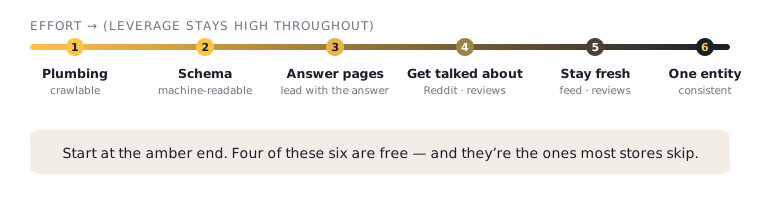
None of this requires an enterprise budget. Here’s the order I’d actually do it in for a small store — cheapest and highest-leverage first — with Whisker & Co. to keep it concrete.
-
Fix the plumbing first (Free). Before anything else, make sure AI crawlers can even read you. Check that your
robots.txtisn’t blocking AI bots (GPTBot, PerplexityBot, Google-Extended), that your CDN or firewall isn’t quietly filtering them, and that pages render content server-side rather than only in JavaScript. No tactic helps if the crawler hits a wall. Whisker & Co. finds its Cloudflare bot rules were blocking two AI crawlers — a one-afternoon fix that unlocked everything else. -
Add product schema (Free · high-leverage). Mark up every product with structured data: price, availability, brand/GTIN, and crucially review attributes — not just a star rating but descriptive fields like size, cat-weight range, noise level. Engines use those exact attributes to answer long-tail questions like “quiet litter box for a nervous cat.” Whisker & Co. adds Product + Review + AggregateRating schema and starts speaking the engines’ language.
-
Write answer-shaped content (Cheap). Stop writing keyword pages; start writing the answer to a real question. A page titled “Best automatic litter box for small apartments (2026)” that opens with a direct, honest one-paragraph answer — then explains the trade-offs — is exactly what an engine wants to quote. Lead with the answer; don’t bury it six headings down.
-
Get talked about where engines listen (Hard · decisive). Because third-party sources — especially Reddit and review sites — carry so much weight, the highest-value work is off your own site: genuinely helpful participation in the communities your buyers use, earning honest reviews, and getting included in independent round-ups. This is slow and can’t be faked; engines are tuned to discount astroturf. For Whisker & Co., a few authentic Reddit threads and one independent “best litter boxes” review do more than fifty blog posts.
-
Keep the feed and reviews fresh (Ongoing). Accurate stock, current prices, and a steady trickle of new reviews that mention specific use cases. Freshness is a ranking signal and a trust signal at the same time.
-
Be one consistent entity everywhere (Ongoing). Same brand name, same description, same key facts across your site, social profiles, marketplace listings, and third-party mentions. Consistency is how a model becomes confident enough to actually name you.
07. How to measure it without spending a cent
You don’t need to buy anything to get a baseline — and you shouldn’t, until you know where you stand. The core metric is your AI Visibility Score (sometimes “Share of AI Voice”): of the relevant questions shoppers ask, in what share does your brand get named? If Whisker & Co. appears in 6 of 30 tracked prompts, that’s a 20% score — and you can track competitors the same way.
The free method · a prompt library
Write down 20–40 real questions a shopper in your category would ask an assistant — by use case (“best litter box for a small apartment”), by attribute (“quietest self-cleaning litter box”), by comparison (“Whisker & Co. vs Litter-Robot”), and branded (“is Whisker & Co. any good”). Once a month, run them through ChatGPT, Perplexity, and Google’s AI Overview, and log three things per answer: were you mentioned, were you described accurately, and where did you sit relative to competitors. That’s it. An afternoon, zero cost, and it tells you more than most dashboards.
When you outgrow the spreadsheet — when you’re tracking enough prompts that manual runs genuinely hurt — that’s the signal to look at tooling. Not before.
If you want a ready-made prompt library instead of starting from a blank sheet, use our 50 AI search prompts for ecommerce brands and run a small baseline before paying for software.
08. The tools — an honest, vendor-neutral map
Here’s where most “AI visibility” articles quietly become an ad for whoever wrote them. We don’t sell one, so here’s the real landscape — starting with the two things nobody selling a tool wants to say out loud.
One: most of these tools only monitor. The market raised over $300M in 2025–2026 and it’s real, but the vast majority of products tell you where you’re invisible without helping you fix it. Buying an expensive monitoring dashboard before you have the team or plan to act on it is buying a very pretty scoreboard.
Two: the tools you find by Googling “AI visibility tools” are often just the ones best at SEO — not necessarily the best products. Several category leaders barely appear in search because they sell through demos and word of mouth. (Profound, widely considered the leader, raised around $155M at a reported billion-dollar valuation, yet it’s easy to miss in a quick search.) Don’t mistake search ranking for quality — which is, after all, the whole point of this guide.
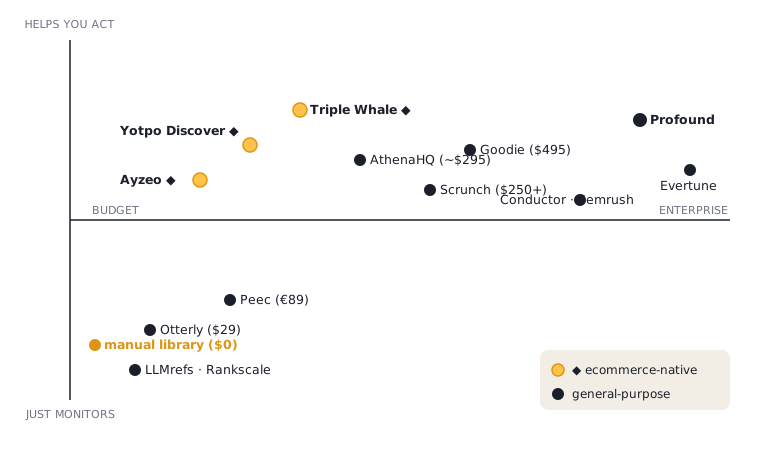
With that said, here’s the landscape by who each tool is actually for. For a ranked shortlist with prices, quick picks, and ecommerce fit, see our best AI visibility tools for ecommerce hub.
Start here — free
Every store, before spending anything
- A manual prompt library — $0, and genuinely the right first step (see section 6).
- Free audits & graders — Otterly’s free GEO tools, HubSpot’s AEO grader, and various one-time audits give you a quick snapshot of whether crawlers can read you.
- Triple Whale’s free AI Visibility tool (ecom) — notable because it’s built for ecommerce specifically.
Budget monitoring · ~$29–$100/mo
Solo sellers & small stores
- Otterly.AI — ~$29 entry; tracks ChatGPT, Perplexity, Google AI Overviews and Copilot (Gemini and AI Mode as add-ons), with GEO audits. Unusually for the price, it ships an MCP server and a Claude skill. The friendliest on-ramp; prompts are capped tight at the low tiers.
- Peec AI — ~€89/$95; clean competitor-benchmarking across several engines; raised ~$29M and growing fast. Strong on measurement, lighter on telling you what to do next.
- LLMrefs, Rankscale, Geneo — other low-cost entries; check refresh frequency and prompt caps before committing.
Mid-market · ~$150–$500/mo
Growing brands with someone to act on the data
- AthenaHQ (~$295) — adds an “action center” of recommendations; built by ex-Google/DeepMind people.
- Scrunch AI ($250–$500) — leans into accuracy and hallucination detection (catching when AI says something wrong about you) and an “agent experience” layer.
- Goodie AI (~$495) — broad engine coverage including Amazon Rufus, which matters if conversational shopping on Amazon is in your future.
Enterprise · custom, often $399–$3,000+/mo
Big catalogs, dedicated teams — overkill for most independents
- Profound — widely seen as the category leader; 9–10 engines including ChatGPT Shopping and Amazon Rufus, SOC 2, deep integrations. Powerful, and far more than a small store needs.
- Evertune ($3,000+) — Fortune-500-oriented, with an unusual “AI retargeting” feature that buys ads against the URLs AI cites.
- Conductor, Semrush AI Toolkit, Ahrefs Brand Radar — established SEO suites bolting on AI-visibility modules; convenient if you already pay for them.
Ecommerce-native (ecom)
Worth a hard look — they speak “products,” not just “brands”
- Triple Whale — built for DTC/Shopify; its real edge is tying AI visibility to revenue and attribution alongside your other store metrics. Free tier to start.
- Alhena AI — ecommerce AI concierge with shopping assistance, support automation, and SKU-level AI visibility claims in one bundle.
- Yotpo Discover — pairs reviews/UGC with agents that build review-backed content; since reviews are a major AI trust signal, the angle is sound.
- Ayzeo — ecommerce-focused: tracks how AI chatbots recommend your products and attributes AI-driven revenue.
If you’re a small independent store, my honest read: do the free playbook first, measure with a manual prompt library or a budget tracker like Otterly, and only consider an ecommerce-native platform once AI is sending you enough traffic to be worth optimizing against. The order matters more than the logo.
Affiliate note
Some tool links in this guide are affiliate links — if you sign up, we may earn a commission at no extra cost to you. It never changes what we recommend or the order tools appear in; placement here is by fit, not payout. If a free option is the right call, we’ll say so (and above, we did).
09. Where this is going — and what to do this week
The near future is agentic shopping: assistants that don’t just recommend but compare, add to cart, and buy on a shopper’s behalf. ChatGPT already has shopping features; Amazon’s Rufus answers product questions inside the store; Google’s Shopping Graph lets people buy from inside an AI answer. As that matures, being the product the agent picks becomes as important as being the link a human clicks — and the inputs are the same ones in this guide: clean structured data, real reviews, third-party trust, a consistent brand.
You don’t need to do everything. This week, do three things:
Your week-one checklist
1. Check your
robots.txtand confirm AI crawlers aren’t blocked. 2. Write down 20 questions your shoppers would ask an assistant, and run them through ChatGPT and Perplexity to get your baseline score. 3. Pick your single best product and make sure its page has complete schema and opens with a plain answer to the question it’s the answer to.
That’s a week’s work, it’s free, and it’s the foundation everything else sits on. The shelf moved. The stores that notice early — and quietly make themselves easy for the answer to name — are the ones that will own the next decade of discovery.
Methodology & transparency
This guide synthesizes public reporting from across the AI-visibility industry — including Triple Whale, Bain & Company, Reuters, and product documentation from the tools named — as of June 2026. Figures come from vendor and analyst sources that each have commercial interests; we’ve flagged that where it matters and rounded for readability. ecomaireviews.com is independent and reader-supported: some tool links are affiliate links that may earn us a commission, but no vendor paid for inclusion, placement, or a favorable description, and we don’t sell an AI-visibility product. Spot something out of date or wrong? Tell us — we update.
Comments